Which U.S. data releases move the Treasury curve?
Verdict
- Size of move (release day): Robust only for the jobs report (2- to 10-year). CPI comes close but does not survive correction.
- Direction (release day): Not Significant anywhere (0 of 35 cells).
Inflation and jobs data make the short-to-belly of the curve move more than a normal day. But which way yields go is statistically unpredictable across every release and every maturity tested.
Bottom line: Some U.S. releases reliably make Treasuries move more — they do not tell you which way.
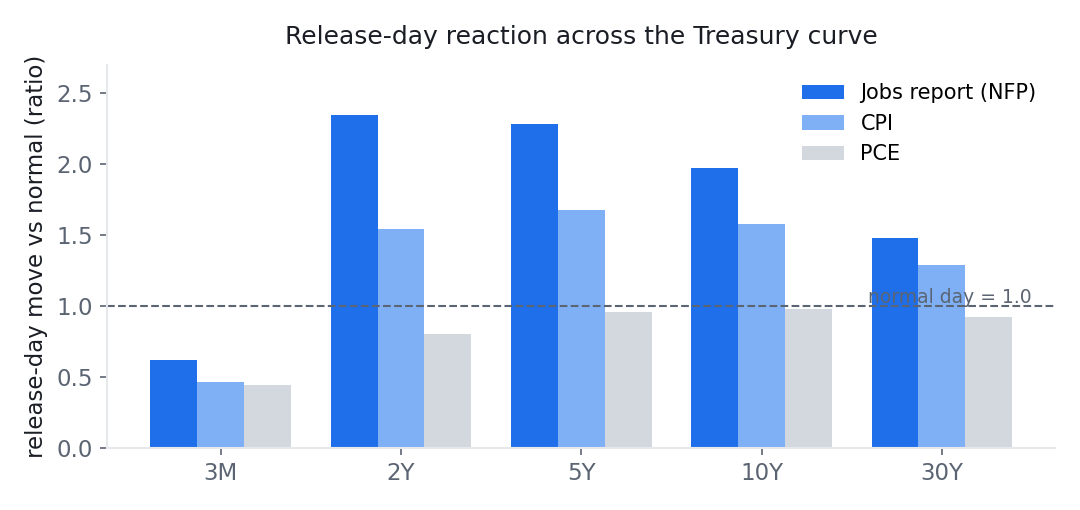
Release-day reaction across the curve for the jobs report, CPI, and PCE (ratio of 1.0 = a normal day). Chart: Macro or Noise, from Federal Reserve Board data via FRED (public domain).
The map
Each cell is the average absolute release-day move versus a normal day (a ratio). Bold = survives Benjamini-Hochberg multiple-testing correction (FDR, q=0.05). Plain numbers above 1.0 look elevated but do not survive correction — we treat those as not robust.
| Release | N | 3M | 2Y | 5Y | 10Y | 30Y |
|---|---|---|---|---|---|---|
| CPI | 37 | ×0.46 | ×1.54 | ×1.68 | ×1.58 | ×1.29 |
| PPI | 36 | ×0.52 | ×1.48 | ×1.47 | ×1.33 | ×1.08 |
| Jobs report (NFP) | 36 | ×0.62 | ×2.35 | ×2.28 | ×1.97 | ×1.48 |
| PCE | 35 | ×0.44 | ×0.80 | ×0.96 | ×0.98 | ×0.92 |
| Retail sales | 38 | ×0.45 | ×1.29 | ×1.42 | ×1.32 | ×1.08 |
| Jobless claims | 150 | ×0.44 | ×1.06 | ×1.17 | ×1.15 | ×1.01 |
| FOMC decision | 24 | ×0.52 | ×1.61 | ×1.74 | ×1.45 | ×0.99 |
What the map says
- The belly reacts most. The 2-to-5-year part of the curve shows the largest release-day moves. The jobs report at the 2-year (×2.35) and 5-year (×2.28) are the standout cells, and the only ones that survive multiple-testing correction. CPI is next (×1.68 at the 5-year) but does not clear that bar.
- The 3-month bill is calmer on release days, not louder. Every release shows a ratio well below 1.0 at the 3-month point. The front of the curve is anchored to the current policy rate, so a single data print barely disturbs it.
- The long end is muted. By the 30-year, most of the reaction has faded; nothing there is robust.
- Looks-significant ≠ is-significant. CPI, PPI, retail sales and the FOMC decision all show ratios above 1.4 at some maturities, but none survive the multiple-testing correction. Run enough comparisons and some will look large by chance — so we discount them rather than headline them.
- Direction is unpredictable everywhere. Across all 35 cells, the average signed move is statistically indistinguishable from zero. Not one maturity, for any release, shows a robust direction.
Methodology
- Horizon: release day (prior close to release-day close, look-ahead protected).
- Move size: average absolute change on release days divided by the average absolute change on all days (the baseline). A ratio of 2.0 means "twice a normal day."
- Direction: one-sample t-test of the signed change against zero.
- Significance of the size: bootstrap against the unconditional baseline (5,000 resamples). The cells that survive correction here have raw bootstrap p-values at or below 0.0002; robustness is decided by the FDR step below, not by a fixed p-value cutoff.
- Multiple testing: Benjamini-Hochberg FDR at q=0.05, applied across the whole grid. This is what separates bold (robust) from plain (not robust).
Caveats
- Adjacent maturities move together, so the effective number of independent tests is smaller than the cell count; the FDR correction is therefore conservative.
- GDP is omitted here — only 12 advance releases fall in the window, too few for a stable estimate. See the separate GDP guide for that low-N result, reported honestly.
- No surprise-versus-forecast conditioning is applied; this measures the release-day reaction itself, not a reaction split by how far the number missed expectations.
- Historical statistics for informational purposes only, not financial advice. Results may vary with sample, period, and baseline definition.
Per-release detail
Each release has its own write-up with the full direction-and-volatility breakdown:
- Does CPI move the 10-year Treasury yield?
- Does a Fed rate decision move Treasury yields?
- Do jobs reports (NFP) move Treasury yields?
- Does PPI move Treasury yields?
- Does GDP move Treasury yields?
- Do retail sales move Treasury yields?
- Do weekly jobless claims move Treasury yields?
Sources
- Treasury constant-maturity yields (3M, 2Y, 5Y, 10Y, 30Y), Federal Reserve Board via FRED (Tier A) — DGS2, DGS5, DGS10, DGS30, DGS3MO
- Release dates: U.S. Bureau of Labor Statistics (CPI, PPI, jobs report), Bureau of Economic Analysis (PCE), Census Bureau (retail sales), Department of Labor (jobless claims), Federal Reserve (FOMC) — all public domain.