Does PCE inflation move the U.S. dollar?
Most similar past releases: December 2012, February 2013, February 2014
Reported figure: U.S. government release. Market move: change from the prior close, Federal Reserve Board data via FRED. "Normal day" is that calendar year's average daily move. Browse every release.
The Personal Consumption Expenditures (PCE) price index is the inflation measure the Federal Reserve says it watches most closely — its 2% target is defined in PCE terms, not CPI. On paper, that makes PCE a top-tier release, and you would expect the U.S. dollar to react when it lands. We tested that expectation across 35 PCE release days against the broad trade-weighted dollar. The answer is a clean, and slightly surprising, no.
Verdict
- Direction (release day): Not Significant
- Volatility (release day): Not Significant
- Volatility (5 days): Not Significant
PCE is the Fed's preferred inflation gauge — but the U.S. dollar barely reacts. On PCE release days the dollar moves about as much as a normal day (0.7×), with no consistent direction.
Bottom line: PCE is old news by the time it lands — CPI already moved the market about two weeks earlier, so the dollar shrugs.
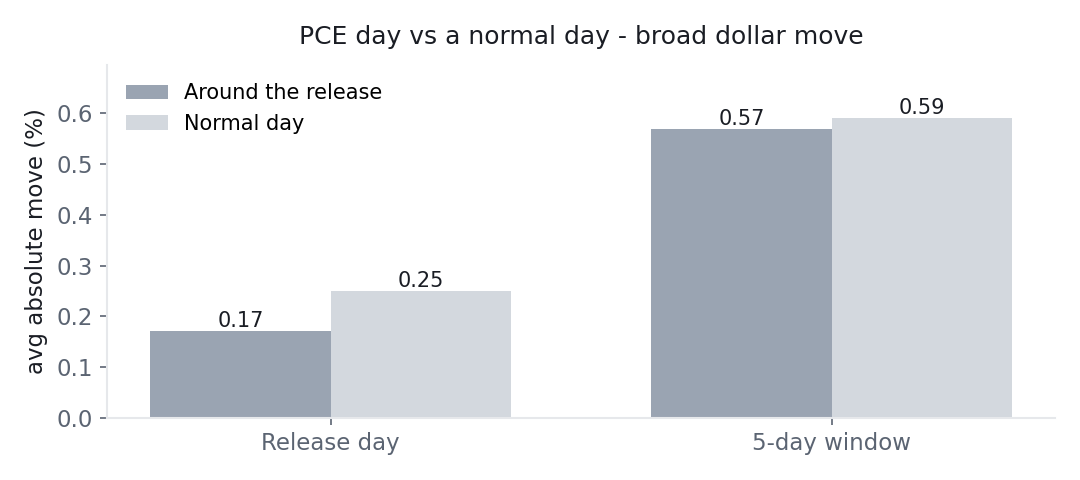
Average absolute broad-dollar move around PCE releases versus normal days (N=35). Chart: Macro or Noise, from Federal Reserve Board data via FRED (public domain).
What the numbers say
On release day, the broad dollar moved about 0.17% versus roughly 0.25% on a normal day — that is 0.67× a normal day, i.e. quieter than average, not louder. There is no volatility event here at all: the elevated-move test returns p=0.99, meaning release-day moves are, if anything, smaller than usual. Direction is likewise a wash (about −0.02%, p=0.67). Over a five-day window the dollar is still moving at roughly a normal pace.
So one of the Fed's most important inputs produces essentially no measurable reaction in the currency on the day it prints. Why?
Why the dollar shrugs at the Fed's favorite gauge
The most likely explanation is timing. PCE is released near the end of the month, about two weeks after the CPI report for a similar period. By the time PCE arrives, the market has already digested the month's inflation story from CPI (which, as our CPI → dollar and CPI → 10-year tests show, is the release that actually carries the inflation news). PCE mostly confirms what traders already concluded, so there is little fresh information left to move the currency.
This is a recurring theme across our tests: a release moves markets in proportion to how much new information it carries, not how important it sounds. A gauge the Fed prizes can still be a non-event for traders if it arrives after the news has already broken.
What this means in practice
- PCE day is not a dollar event. On the evidence, it moves the broad dollar less than an ordinary day — the opposite of a volatility spike.
- "The Fed's preferred gauge, so it must move the market" does not follow. Importance to policymakers and reaction in prices are different things.
- CPI is where the inflation reaction lives. If you want the market-moving inflation release, it is CPI, not PCE.
None of this is advice — it is a description of what 35 releases actually did, and results can change with a different sample, period, or definition.
Key findings, generated from the data
- Across 253 releases, the USD moved an average of 0.24 % on release day (absolute).
- The largest single reaction was -1.22% on 2022-12-01 (November 2022 data).
- Splitting by our trend-based surprise shows no reliable directional pattern: pooled p=0.66, and by era — 2000-2012: -0.06 (p=0.44); 2013-2019: +0.05 (p=0.46); 2020-2026: -0.01 (p=0.92). Note the sign is not even stable across periods.
- Because our surprise is a trend proxy rather than a market consensus, and because these splits are sensitive to the period chosen, treat all of the above as patterns observed in this sample rather than as established effects.
- Surprise size does not clearly scale the reaction: the largest third of surprises averaged 0.26 versus 0.21 for the smallest third (p=0.11).
Generated automatically from our event database by a rule-based script (no language model). "Surprise" is model-based — the reading minus the average of the previous three — and is not a market consensus forecast. See every release in the database.
The data
| Dimension | Horizon | Value | Baseline | Test stat | p-value | Verdict |
|---|---|---|---|---|---|---|
| Direction | release day | -0.02% | 0.00% | -0.43 | 0.673 | Not Significant |
| Volatility | release day | 0.17% | 0.25% | 0.67 | 0.987 | Not Significant |
| Volatility | 5 days | 0.57% | 0.59% | 0.96 | 0.587 | Not Significant |
Methodology
- Events (N): 35 PCE releases.
- Window: 2023-01-27 → 2025-12-23.
- Measurement: the percentage change in the broad dollar index from the prior close to the close at the end of the holding window (look-ahead protected).
- Baseline: the unconditional distribution of same-length percentage returns across all trading days.
- Tests: one-sample t-test of the signed return against zero (direction), and a bootstrap of the absolute return against the baseline (size).
Caveats
- This tests the broad U.S. dollar index; PCE may still move other assets (e.g., Treasuries) somewhat more.
- The event study above does not condition on surprise: it measures the reaction to the release itself. The "Key findings" block does add a split by our own trend-based proxy, which is not a market consensus forecast — consensus data is proprietary and outside our public-domain sources.
- The window spans 2023–2025; the late-2025 schedule was affected by the federal government shutdown (dates taken from the actual FRED release record).
- Historical statistics for informational purposes only, not financial advice. Results may vary with sample, period, and baseline definition.
Related tests
- Does CPI move the U.S. dollar? — the inflation release that arrives first.
- Do U.S. data releases move the dollar or oil? — the full picture for the currency.
- Which U.S. data releases move the Treasury curve? — where PCE does and does not register.
Source
- Nominal Broad U.S. Dollar Index, Federal Reserve Board via FRED (Tier A, U.S. public domain) — DTWEXBGS.
- PCE / Personal Income and Outlays release dates, U.S. Bureau of Economic Analysis — Personal Income & Outlays.