Do U.S. data releases move the dollar or oil?
Verdict
- Size of move (release day): Not Significant for any release, in the dollar or in oil, after multiple-testing correction.
- Direction (release day): Not Significant anywhere.
The broad dollar and crude oil do not reliably react to U.S. macro releases on the day they print. A few cells look mildly elevated, but none survive correction.
Bottom line: Unlike the front of the Treasury curve, the dollar and oil mostly shrug off the U.S. data calendar on release day.
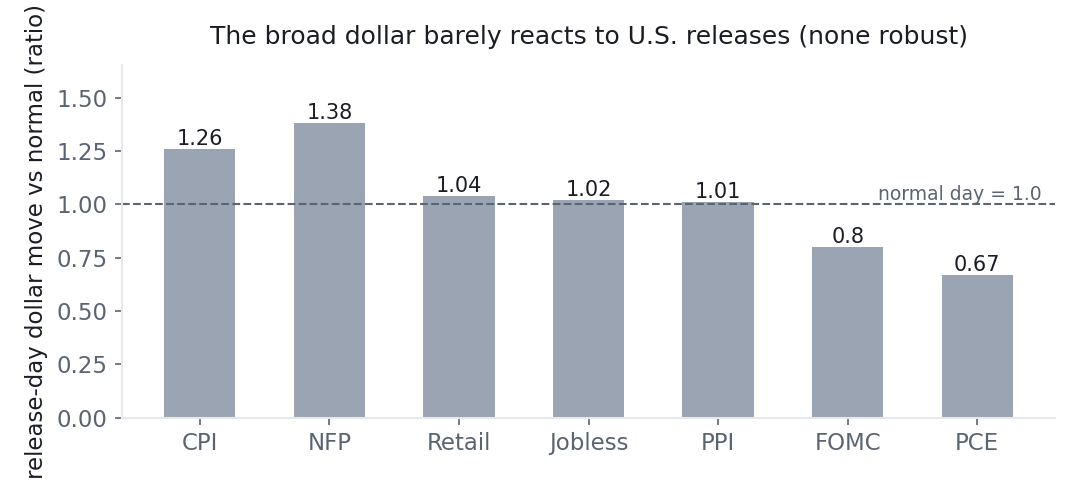
Broad-dollar release-day move versus a normal day, by release (none survive multiple-testing correction). Chart: Macro or Noise, from Federal Reserve Board data via FRED (public domain).
The map
Each cell is the average absolute release-day move versus a normal day. The dollar is the Fed's broad trade-weighted index; oil is WTI and Brent spot. No cell survives Benjamini-Hochberg correction (FDR, q=0.05), so none is shown in bold.
| Release | N | Broad USD | WTI | Brent |
|---|---|---|---|---|
| CPI | 37 | ×1.26 | ×0.96 | ×0.84 |
| PPI | 36 | ×1.01 | ×0.78 | ×0.85 |
| Jobs report (NFP) | 36 | ×1.38 | ×1.01 | ×1.11 |
| PCE | 35 | ×0.67 | ×0.62 | ×0.63 |
| Retail sales | 38 | ×1.04 | ×0.88 | ×1.00 |
| Jobless claims | 150 | ×1.02 | ×0.77 | ×0.85 |
| FOMC decision | 24 | ×0.80 | ×0.86 | ×0.91 |
What the map says
- The dollar's biggest reactions — the jobs report (×1.38) and CPI (×1.26) — are real-looking but not robust. They do not survive multiple-testing correction, so we do not headline them as effects.
- Oil barely notices. WTI and Brent sit at or below a normal day for almost every release. The intraday oil market is driven far more by supply, inventories, and geopolitics than by the U.S. macro print of the morning.
- PCE day is quieter than average in both the dollar (×0.67) and oil (×0.62-0.63) — a calm, pre-telegraphed release rather than a market-moving surprise.
- Direction is unpredictable. As with Treasuries, the signed release-day move is statistically indistinguishable from zero across the board.
This is the kind of result the site exists to publish: a widely assumed link — "inflation data moves the dollar and oil" — that does not hold up on the day, once you compare against a baseline and correct for multiple tests.
Methodology
- Horizon: release day (prior close to release-day close, look-ahead protected).
- Move size: average absolute percentage return on release days divided by the average on all days (the baseline).
- Direction: one-sample t-test of the signed return against zero.
- Significance: bootstrap against the unconditional baseline (5,000 resamples), then Benjamini-Hochberg FDR at q=0.05 across the grid.
Caveats
- No surprise-versus-forecast conditioning; this is the release-day reaction itself, not a reaction split by how far the number missed expectations.
- "No robust release-day effect" is not "no effect ever" — longer windows, or conditioning on large surprises, could look different.
- Historical statistics for informational purposes only, not financial advice. Results may vary with sample, period, and baseline definition.
Related
- Does CPI move the U.S. dollar?
- Does PCE inflation move the U.S. dollar?
- Which U.S. data releases move the Treasury curve?
Sources
- Broad U.S. Dollar Index, Federal Reserve Board via FRED (Tier A) — DTWEXBGS
- WTI and Brent crude spot, U.S. Energy Information Administration via FRED (Tier A) — DCOILWTICO, DCOILBRENTEU
- Release dates: U.S. Bureau of Labor Statistics (CPI, PPI, jobs report), Bureau of Economic Analysis (PCE), Census Bureau (retail sales), Department of Labor (jobless claims), Federal Reserve (FOMC) — all public domain.